
How to Find True to Size Clothing Online
Posted on septembre 04 2026

Table of Contents
- Why Finding True to Size Clothing Online Feels Impossible
- How to Measure Yourself for Clothing: The 4 Numbers You Need
- How to Read Size Charts Online Like a Pro
- Fabric Matters: Shrinkage, Stretch, and Fit
- What True to Size Really Means (and When to Size Up or Down)
- Tips for Avoiding Returns on Online Clothing Orders
- Your Fit Cheat Sheet: A Simple Pre-Order Checklist
- Conclusion: Shop Confidently, Dress Comfortably
- Frequently Asked Questions
Last Updated: September 5, 2026
Online shopping is a guessing game for most people, and the biggest gamble is always fit. When you order a "medium" from one brand and it fits like a small from another, the problem isn't your body, it's the lack of standardized sizing across the industry. At Betty Be Good Boutique, we hear from customers daily who are frustrated by inconsistent sizing, which is why we built this guide on how to find true to size clothing online without the hassle of returns.
The good news is that finding true to size clothing online is a skill you can learn in about ten minutes. It requires reading the size chart, taking your own measurements, and understanding how fabric behaves. Below, we'll walk you through a simple pre-order routine that eliminates most fit failures before they happen.
Why Finding True to Size Clothing Online Feels Impossible
The core issue is that clothing sizes are not standardized. A size 8 from one retailer can measure completely differently than a size 8 from another, a practice known in the industry as vanity sizing, where brands adjust measurements to make customers feel thinner. This is why your closet likely holds three different sizes that all fit the same.
Most guides get this wrong by telling you to simply "know your size." The reality is that your size number means almost nothing across different brands. The only reliable way to shop is to ignore the label entirely and compare your actual body measurements against the specific garment measurements listed for each item.
How to Measure Yourself for Clothing: The 4 Numbers You Need
Learning how to measure yourself for clothing takes less than five minutes with a soft tape measure, which is flexible fabric or plastic, not a metal carpenter's tape. Wear minimal, form-fitting clothing and stand naturally with your feet together.
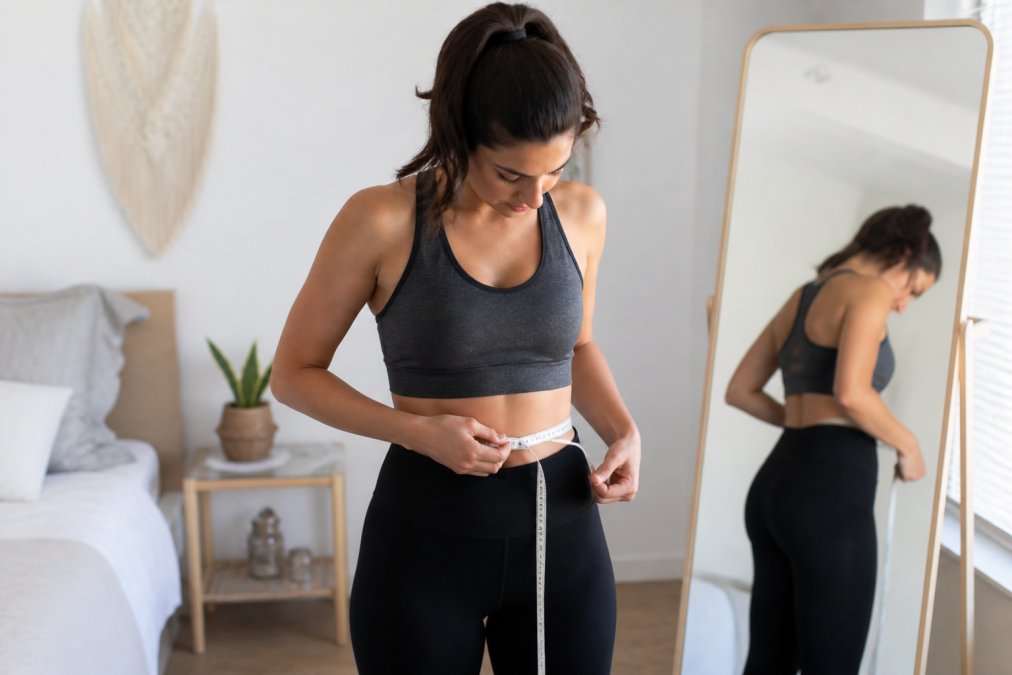
Focus on these four numbers for tops and dresses:
- Bust: Measure around the fullest part of your chest, keeping the tape level across your back.
- Waist: Measure around your natural waistline, which is the narrowest part of your torso, usually near your belly button.
- Hips: Measure around the fullest part of your hips and bottom, about 20 cm below your waist.
- Shoulder to hem: For dresses and longer tops, measure from the top of your shoulder down to where you want the garment to end.
Record these numbers in a notes app on your phone. This is your personal fit baseline, and you will use it every time you shop online.
How to Read Size Charts Online Like a Pro
A size chart is only useful if you know what you are comparing. Most retailers provide two types of measurements: body measurements, which tell you what body size the garment is designed for, and garment dimensions, which are the actual measurements of the clothing laid flat.
The key is to compare your body measurements against the retailer's body measurement chart. If a chart only lists garment dimensions, you need to account for "ease," which is the extra room built into a garment beyond your body size. For example, a top with a 96 cm bust measurement is designed for a body with a roughly 90 cm bust, allowing about 6 cm of wearing ease.
A common mistake is assuming your standard size matches the chart. Always check the specific chart for each item, since a single brand can cut different styles differently. A fitted knit dress will have less ease than a loose woven blouse, even in the same size.
Fabric Matters: Shrinkage, Stretch, and Fit
Fabric composition is the most overlooked factor in online fit. A 100% cotton top that fits perfectly on arrival may shrink two to three percent in the first wash, while a fabric with spandex will stretch with wear and snap back. This is why the same size in different materials fits differently.
Before ordering, check the fabric breakdown in the product description. Natural fibers like cotton and linen are prone to shrinkage, so consider sizing up if you plan to machine wash and dry. Synthetic blends with elastane or spandex offer stretch and recovery, meaning they hold their shape and can often be bought in your usual size.
What True to Size Really Means (and When to Size Up or Down)
True to size is a claim that a garment's measurements align with the brand's own size chart. It does not mean the garment matches another brand's size chart. When a retailer says a piece is true to size, they are telling you that if you follow their chart, the fit will match the intended silhouette. This definition is straightforward, but the reality of shopping online is complicated by one massive factor: international sizing.
The dirty secret of the fashion industry is that a size "medium" or a size "10" means something entirely different depending on where the brand is based. A size 10 from a Canadian or US brand is not the same as a size 10 from a UK brand, which is not the same as a size 42 from a European brand. This is not just a label difference; the actual physical measurements differ. A US size 10 typically corresponds to a UK size 14 and a European size 42. If you are shopping from a brand that uses European sizing, you cannot simply convert your US size by subtracting a number. You must look at the specific centimeter measurements on their chart.
The most confusing part is the difference between the US and UK systems. The US system is based on a dress form from the 1950s, while the UK system uses a different baseline. This is why a US size 6 is a UK size 10. The gap widens as sizes increase. For example, a US size 16 is a UK size 20. This is a full four-size difference, which is why ordering a "medium" from a UK-based brand when you are a US "medium" will often result in a garment that is far too large.
Asian sizing, particularly from Japanese and Korean brands, adds another layer of complexity. These markets typically run significantly smaller than Western sizes. A Japanese size "Large" might be equivalent to a US "Small" or even "Extra Small" in the bust and waist. If you are ordering from a brand based in Japan, you will almost always need to size up one to two sizes from your usual Western size, and you must rely on the garment's flat measurements rather than the letter on the tag.
So, when should you size up or down? Here is a practical framework that goes beyond the label:
- If you are between sizes: The fabric is your tiebreaker. Choose the smaller size for stretchy knits with 5% or more elastane, and the larger size for rigid wovens with no give.
- If the brand is based in the UK or EU: Expect the fit to run larger than US brands. Check the centimeter measurements carefully, as you may need to size down compared to your US size.
- If the brand is based in Japan or Korea: Expect the fit to run smaller. Plan to size up one to two sizes from your usual, and always verify the shoulder width and bust measurements, as these are often the tightest points.
- If the garment is a structured piece (blazer, tailored dress): Size up if you are between sizes, as tailoring requires a precise fit and has no give.
- If the garment is a relaxed or oversized silhouette: The brand's size chart will tell you the intended ease. If you want the model's look, order the size that matches the model's measurements, not your usual size.
Ultimately, the term "true to size" is only useful within a single brand's ecosystem. Across brands and borders, it is meaningless. Your only defense is to treat every size chart as a new data set and to use your own body measurements as the constant. This approach helps you to shop from any retailer, anywhere in the world, with confidence.
Tips for Avoiding Returns on Online Clothing Orders
The most effective way to avoid returns is to stop ordering based on your usual size and start ordering based on measurements. This is the foundation of any good strategy for tips for avoiding returns on online clothing orders. It takes an extra two minutes per order but saves you the hassle of packaging and shipping items back.
A practical pre-order routine includes checking the retailer return policy before you buy. Even the best measurement process has occasional misses, so you want the safety net of a straightforward exchange. Look for retailers that clearly state their return window and process on their website.
For example, at Betty Be Good Boutique, every product listing includes detailed fit notes, such as "length is 15 cm below the waistband" or "bust is loose," which removes the guesswork. Our Cotton V-Neck Layering Tee is a great example of a true to size staple, with a fabric blend of 95% cotton and 5% spandex that offers both breathability and stretch.

Your Fit Cheat Sheet: A Simple Pre-Order Checklist
Use this checklist before you hit "add to cart" on any new piece of clothing online.
| Check | What to Do | Why It Matters |
|---|---|---|
| 1. Measure | Take your bust, waist, and hip measurements with a soft tape measure. | Your baseline for every size chart. |
| 2. Compare | Check the item's size chart against your measurements. | The label size is irrelevant; the numbers decide. |
| 3. Check Fabric | Read the fabric composition for stretch and shrinkage. | Cotton shrinks; spandex stretches; know before you wash. |
| 4. Read Fit Notes | Look for specific notes like "loose at bust" or "true to size." | Tells you the intended silhouette, not just the size. |
| 5. Review Policy | Confirm the return and exchange policy. | You need a safety net for the occasional miss. |
Conclusion: Shop Confidently, Dress Comfortably
Finding clothes that fit well online is about shifting your mindset from guessing sizes to comparing measurements. When you focus on your body measurements and the garment's specific dimensions, you take the chance out of the process and start building a wardrobe that works for you.
At Betty Be Good Boutique, we make this easy by listing detailed fit notes and fabric compositions on every product, so you can shop with confidence. Our pieces ship from within Canada to Canada, with no duty or overseas returns, and enjoy free shipping within Canada and to the US on orders over $99. Explore our Dolman Sleeve Boatneck Top or the Mustard Stripe Rugby Top for pieces that fit as good as they look. Get started with Betty Be Good Boutique and find clothing that feels true to you.


Frequently Asked Questions
Why do clothing sizes vary so much between brands?
There is no standardized sizing system across the fashion industry. Each brand creates garments using its own fit model, which is a person with specific body measurements that designers use as a template. One brand's medium might match another brand's large. This is why relying on your usual letter size rarely works. Instead, measure your body and compare those numbers to each brand's size chart. That approach gives you accurate results every time, regardless of how inconsistent the industry is.
How do I measure myself accurately for online clothing?
Use a soft tape measure and wear fitted clothing or underwear. For your bust, wrap the tape around the fullest part, keeping it level across your back. For your waist, find your natural waistline, usually the narrowest point above your belly button. For hips, measure around the fullest part of your bottom. For inseam, measure from your crotch down to your ankle bone. Write the numbers down in inches or centimetres and compare them directly to the brand's size chart.
What does 'true to size' mean in clothing reviews?
When a brand or reviewer says a garment is true to size, it means the item fits according to the measurements on that brand's size chart. It does not mean the item matches your usual size from another store. A top labeled true to size fits exactly as the brand's fit model intended. Always check the specific garment measurements, like bust and length, which many boutiques list in the product description. This gives you concrete numbers to compare against your own measurements.
This article was written using GrandRanker

0 comments