How to Identify Quality Clothing Online: 2026 Guide
Posted on septembre 18 2026

Table of Contents
- Why Quality Clothing Is Harder to Judge Online
- Best Fabrics for Long-Lasting Clothing: What to Look For
- How to Read Clothing Care Labels Before You Buy
- Reading Product Photos: Seams, Stitching, and Construction
- Avoiding Duty Fees on Online Clothing Orders
- Signs of Poor-Quality Clothing and Premature Aging
- Sustainable vs. Quality: What the Correlation Actually Means
- Post-Purchase Wash Testing: The Final Quality Check
- Frequently Asked Questions
Last Updated: September 18, 2026
Why Quality Clothing Is Harder to Judge Online
You cannot touch the fabric, feel the weight, or hold a seam up to the light when you buy online. That missing step is exactly where most disappointing purchases happen.
Learning how to identify quality clothing online comes down to reading what a product page actually tells you. Photos, fabric percentages, and construction details all leave clues.
At Betty Be Good Boutique, we hear the same worry every week: "It looked cute online, but it arrived thin and shapeless." It is fixable.
Best Fabrics for Long-Lasting Clothing: What to Look For
The best fabrics for long-lasting clothing balance natural fibers with a small amount of stretch, modal, cotton, linen, and wool, often blended with a little spandex for shape recovery.
Natural Fibers vs. Synthetic Blends
Natural fibers breathe and soften over time; synthetic blends cost less but trap heat and pill faster.
Here is how the two compare:
- Natural fibers (cotton, linen, wool, modal): breathe well, age gracefully, feel better against skin
- Synthetic blends (polyester, acrylic, nylon): cheaper, wrinkle-resistant, but prone to pilling and static
- Smart blends: mix both for comfort and durability
Reading Fabric Composition Codes Online
Online shopping gives you an advantage over the fitting room: fiber percentages are printed right on the product page, so you can compare ten garments in five minutes.
A few patterns worth memorizing:
- 100% cotton is durable and breathable but shrinks unless it is pre-shrunk. Look for the word "pre-shrunk" or "garment-dyed" in the description.
- 95% cotton / 5% spandex is the classic tee formula. Enough stretch to move, enough cotton to breathe.
- Modal, lyocell, and Tencel are semi-synthetics made from wood pulp. They drape like silk, resist pilling better than polyester, and are often labeled by brand name (Tencel is a trademarked lyocell).
- Polyester above 60% in a garment marketed as breathable is a red flag. It will trap heat and hold odor.
- Viscose and rayon are soft but weak when wet. A 100% viscose dress can lose shape after one careless wash.
Fabric Density, GSM, and the Stretch Test
Fabric density tells you how tightly woven a material is. Denser fabric resists sheerness and sagging.
Since you cannot feel it online, use these proxies:
- GSM (grams per square meter): some brands list this. A lightweight tee runs around 140-160 GSM; a heavyweight tee is 180-220 GSM. Higher GSM generally means a more substantial, longer-lasting fabric.
- Words like "opaque," "not see through," or "structured" in the description
- Fabric weight if listed in ounces or GSM
- Reviews that mention sheerness or thinness, search the review section for "thin," "sheer," or "see-through"
Drape and Structure: Judging Fabric From a Photo
Drape is how a fabric falls on the body. Structure is how well it holds a shape. Both are visible in photos if you know what to look for.
- Fluid drape: the fabric pools softly at the hem and follows the body's curves. Common in modal, viscose, and silk blends.
- Structured drape: the fabric holds an angular shape, like a blazer shoulder or a pleated skirt. Common in wool, heavy cotton, and linen blends.
- Stiff or papery drape: the fabric looks rigid in the photo and does not move with the model. Often a sign of low-quality polyester or an over-starched finish.
How to Read Clothing Care Labels Before You Buy
Learning how to read clothing care labels is one of the fastest ways to avoid a purchase you will regret.
Fiber Content and Washability
Fiber content shows the exact percentages of each material, your clearest quality signal.
Look for:
- Higher natural fiber percentages for softness and breathability
- Small spandex content (5-7%) for stretch and recovery
- Care instructions that match your routine (machine wash beats hand wash for most people)
Reading Product Photos: Seams, Stitching, and Construction
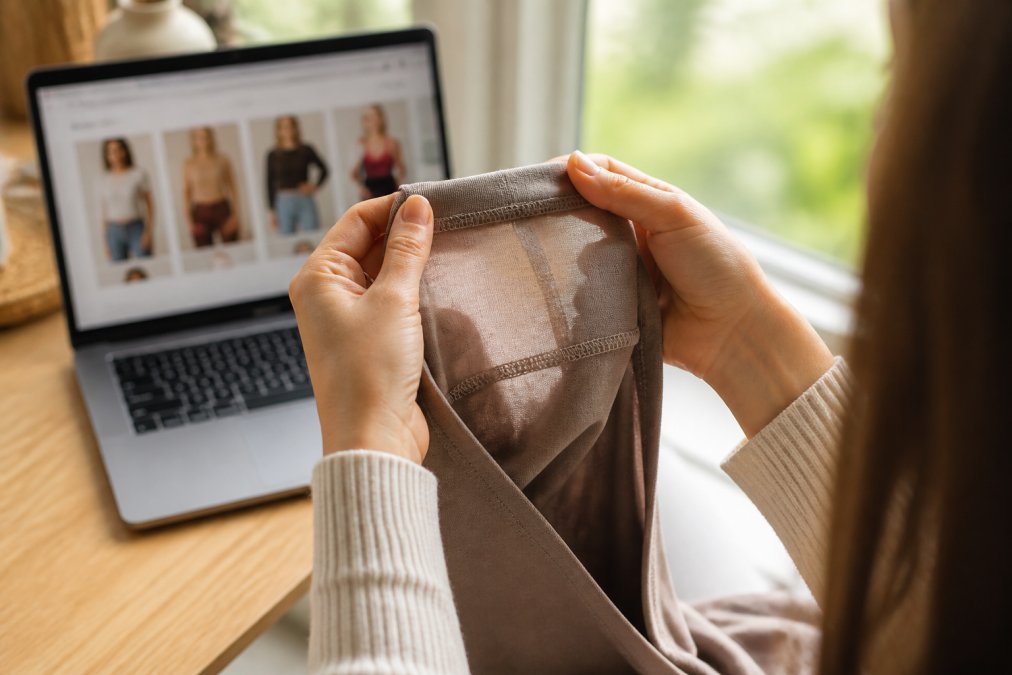
Product photos reveal construction quality if you know what to zoom in on. Since you cannot flip a garment inside out in a fitting room, the product page has to do that work for you, and the best pages show you exactly what to look for.
Stitch Types and Seam Finishes to Look For
Not all stitching is equal. Here is the vocabulary that separates a well-made garment from a disposable one:
- Single stitching: one row of thread along a seam. Common on fast-fashion pieces and the first thing to split under stress.
- Double stitching: two parallel rows. Stronger, and standard on quality denim, tees, and activewear.
- Lockstitch vs. chain stitch: a lockstitch (two threads interlocked) resists unraveling; a chain stitch (one continuous loop) can pull apart if a single thread breaks. Chain stitching at a hem is often a deliberate design choice, not a flaw.
- French seams: the raw edges are enclosed inside a folded seam. You will see this on unlined silk, chiffon, and higher-end blouses because it hides fraying and feels smooth against skin.
- Flat-felled seams: folded and stitched flat, common on jeans and workwear. Very durable.
- Overlocked (serged) edges: a zigzag finish on raw edges. Fine on knits, a warning sign on structured wovens where it suggests cost-cutting.
Pattern Matching and Symmetry
Pattern matching is the quiet tell of a quality garment. On a striped shirt, plaid blouse, or floral print, the pattern should line up across the center front, side seams, and sleeve caps. When it does not, the manufacturer cut corners to save fabric.
Hardware Quality and Buttonhole Reinforcement
Hardware, zippers, buttons, snaps, and fasteners, fails first on cheap garments.
Check for:
- Metal zippers over plastic for durability. YKK is the most widely recognized zipper brand, and many quality labels name it in the description.
- Reinforced buttonholes with tight, even stitching. A buttonhole that looks frayed or loose will stretch out with use.
- Secure fasteners that do not look glued or flimsy. Shank buttons (with a small post underneath) sit better than flat sew-through buttons on structured garments.
- Smooth zipper tracks that glide without catching. A zipper that snags in the product video will snag on you.
Avoiding Duty Fees on Online Clothing Orders
Duty fees can turn a good deal into a bad one. The simplest fix is to buy from a seller that ships within the country you live in.
A few habits that keep costs predictable:
- Check where the seller ships from before you buy
- Read the shipping and returns page carefully
- Look for free shipping thresholds to bundle orders
- Confirm the return address is domestic
Signs of Poor-Quality Clothing and Premature Aging
Poor-quality clothing shows its age fast. Pilling, snagging, fading, and stretched seams appear within a few wears, not years.
Watch for these warning signs before you buy:
- Thin, sheer fabric that shows through in photos
- Single-stitched seams instead of double stitching
- Cheap hardware that looks plated or lightweight
- Vague fabric descriptions with no percentages listed
- No care instructions on the product page
Sustainable vs. Quality: What the Correlation Actually Means
Sustainable clothing and quality clothing are not the same thing, but they overlap more than most shoppers realize: a well-made garment lasts longer, meaning fewer replacements and less waste.
Post-Purchase Wash Testing: The Final Quality Check
Wash testing is the last quality check, and most shoppers skip it. The first wash tells you almost everything about how a garment will age.
Here is a simple wash test routine:
- Wash one new item alone on the recommended setting
- Check for shrinkage by comparing it to the pre-wash fit
- Look for color bleed in the water or on light fabrics
- Inspect seams for loose threads or pulling after the cycle
- Feel the fabric for pilling or stiffness
Frequently Asked Questions
What is the 3-3-3 rule for clothes?
The 3-3-3 rule is a wardrobe guideline: aim for pieces you can wear at least three ways, that suit three different occasions, and that last at least three years. When shopping online, it helps you prioritize versatile, durable quality clothing over trend-driven impulse buys. A modal tee that works for layering, casual wear, and lounging fits the rule well.
What fabrics should I avoid when buying clothes online?
Be cautious with 100% acrylic, low-quality polyester, and fabrics with very high spandex content. These tend to pill, snag, and lose shape quickly. Instead, look for natural fibers like cotton, modal, and linen, or thoughtful synthetic blends. A fabric like 95% modal with 5% spandex, for example, offers softness and recovery without the pilling issues of cheaper synthetics.
Does price always indicate quality in clothing?
No. Price is not a reliable quality signal. A high price can reflect branding, marketing, or retail markup rather than better construction. Instead, check fiber content, seam allowance, stitching type, and lining quality. A well-made piece at a moderate price, like a $49.90 modal tee with double stitching and proper care labeling, can outperform a more expensive garment with poor construction.
How do I avoid duty fees and return hassles when shopping online?
Shop from retailers that ship domestically. When a boutique ships from within Canada to Canada, there are no duty fees or overseas return complications. Look for clear shipping policies and free shipping thresholds. Betty Be Good Boutique, for instance, ships from Canada to Canada with no duty or overseas returns, and offers free shipping on orders over $99 to Canada and the US.

0 comments