Best Online Stores for Ethical and Affordable Fashion 2026
Posted on September 20 2026

Table of Contents
- What Makes Fashion Ethical and Affordable in 2026
- How to Identify Ethical Fashion Brands
- Sustainable Clothing Brands: What to Look For
- Top Picks: Affordable Ethical Fashion Pieces Worth Buying
- How to Build a Capsule Wardrobe on a Budget
- Price Per Wear: The Real Cost of Your Clothes
- Repair, Resale, and Circular Fashion
- Conclusion
- Frequently Asked Questions
Last Updated: September 20, 2026
What Makes Fashion Ethical and Affordable in 2026
Finding the best online stores for ethical and affordable fashion in 2026 is harder than it should be, as these two qualities rarely align. Ethical manufacturing implies living wages, lower-impact fabrics, and smaller production runs, all of which increase costs. This is the affordability paradox, and it's why many shoppers opt for fast fashion instead.
The Affordability Paradox: Why Ethical Often Costs More
A garment made in a small run from certified organic cotton or Tencel costs more per unit than one produced in the tens of thousands. This is simple math, not greed. However, the cost per wear, not the sticker price, is the metric that truly matters: a $90 pair of wide leg pants worn twice a week for two years is more economical than a $30 pair that shows wear by March.

How to Identify Ethical Fashion Brands
Identifying ethical fashion brands involves three key checks: material content, supply chain transparency, and certifications. A brand that clearly states its fabric composition and lists its certifications is generally being truthful, as these claims are auditable. Vague language like "eco-conscious" should be treated as a warning sign.
Greenwashing Red Flags to Watch For
Be aware of these when you shop:
- A sustainability page lacking named certifications.
- "Eco" collections that omit fiber content details.
- Carbon-neutral claims without an explanation of the methodology.
- Marketing of recycled polyester that ignores microplastic shedding.
- A constant stream of new arrivals, which contradicts the principles of slow fashion.
Certifications That Actually Mean Something
Fair trade certification confirms that farmers and garment workers receive fair compensation and work in safe conditions. GOTS (Global Organic Textile Standard) covers organic cotton from the field to the finished garment. OEKO-TEX Standard 100 verifies that a fabric is free from harmful substances. B Corp certification assesses a company's overall social and environmental performance.
Sustainable Clothing Brands: What to Look For
When seeking sustainable clothing brands, prioritize those that allow for verification. Start by considering the shipping distance. A garment shipped domestically avoids cross-border duties, customs delays, and the air freight emissions associated with overseas returns. Local shipping also facilitates easier exchanges.
| What to Check | Why It Matters | Where to Find It |
|---|---|---|
| Fabric composition | Determines durability and care | Product page details |
| Certification logos | Third-party verified claims | Product or About page |
| Shipping origin | Lower carbon footprint, no duty | Shipping policy |
| Return policy | Fewer wasted purchases | Footer or FAQ |
| Price per wear | True cost over time | Your own calculations |
Top Picks: Affordable Ethical Fashion Pieces Worth Buying
The most economical ethical wardrobe is one you actually wear. These pieces are designed for layering, durability, and versatility across seasons, with all items priced under $110, and most under $90.
Everyday Staples Under $100
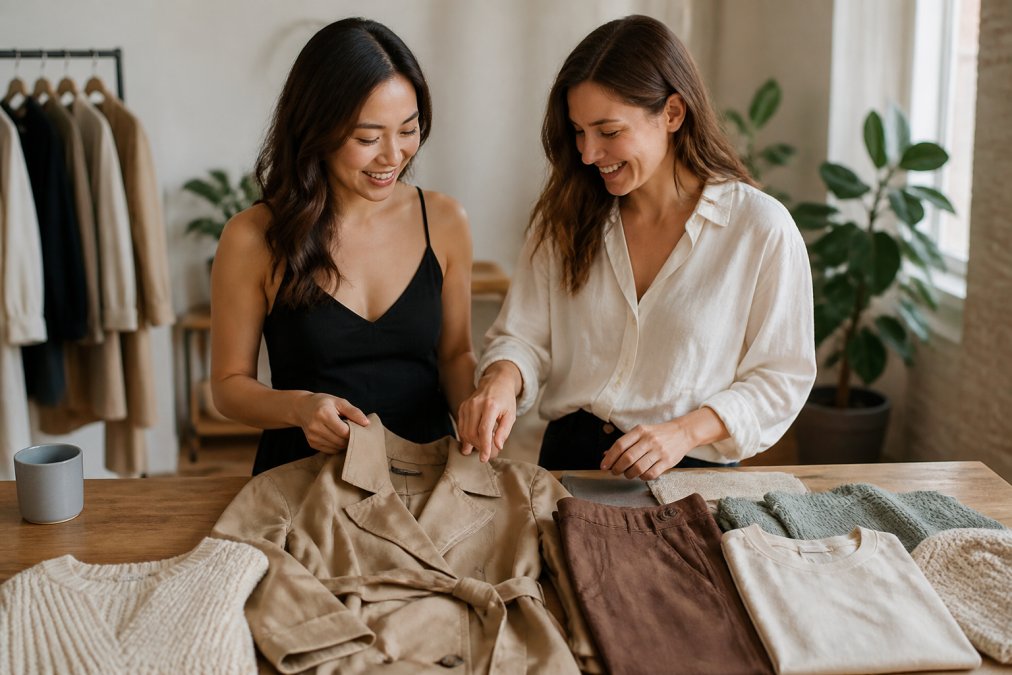
The Modal Roll Sleeve Knit Tee at $34.90 is a versatile staple, composed of 58% cotton, 38% modal, and true to size. The Modal Easy Fit Tee at $49.90 is made of 95% modal, offering a silky smooth feel and a relaxed fit through the bust and waist. For bottoms, the Wide Leg Drawstring Lounge Pants at $74.90 feature functional side pockets and an adjustable drawstring waist. The Tencel Tie Waist Wide Leg Pants at $89.90 are crafted from 100% Tencel and have a 29-inch inseam.

Layering Pieces for Every Season
The Vegan Leather Belted Trench Coat at $109.90 is a standout piece, fitted at the waist and loose through the bust and hips, with a mid-calf length that works over a knit tee or a dress. The Crochet Blanket Cardigan at $89.90 is an oversized, ankle-length layer with ample stretch.

| Piece | Price | Fabric | Best For |
|---|---|---|---|
| Modal Roll Sleeve Knit Tee | $34.90 | Cotton, modal, spandex | Everyday layering |
| Modal Easy Fit Tee | $49.90 | 95% modal | Casual wear, workouts |
| Wide Leg Drawstring Lounge Pants | $74.90 | Polyester knit | Travel, errands |
| Pleated Midi Skirt | $74.90 | Polyester, lined | Dressing up or down |
| Modal Scuba Straight Leg Joggers | $89.90 | Modal, polyester, spandex | Casual to smart |
| Tencel Tie Waist Wide Leg Pants | $89.90 | 100% Tencel | Work and weekends |
| Crochet Blanket Cardigan | $89.90 | Stretch knit | Cool-weather layering |
| Suedette Wide Leg Pants | $89.90 | 100% polyester | Texture-rich outfits |
| Vegan Leather Belted Trench Coat | $109.90 | Polyurethane | Year-round outerwear |
How to Build a Capsule Wardrobe on a Budget
Building a capsule wardrobe on a budget begins with assessing what you already own, rather than creating a shopping list. A successful approach involves auditing your current items, filling gaps one piece at a time, and applying a price-per-wear test to each potential addition before it earns a place.
Step 1: The Wear Audit
Empty your closet and sort items into three categories: wears weekly, wears occasionally, and never wears. Approximately one-third of a wardrobe goes unworn, representing a significant drain on your budget. Items in the "never wears" pile should be repaired, resold, or donated, not kept for a hypothetical future.
Step 2: Identify the Gaps, Not the Wants
A functional capsule typically requires around 30 pieces: 8 tops, 6 bottoms, 4 layers, and 3 dresses, plus shoes and accessories. This is a general guideline, not a strict rule. The critical gaps are those that necessitate purchasing new items because nothing in your current collection meets the need.
Step 3: The Three-Match Rule
Before acquiring any new item, verify that it coordinates with at least three existing pieces in your wardrobe. A neutral knit tee that matches three bottoms and two layers qualifies as a capsule piece. A statement print that only matches one skirt constitutes a one-outfit purchase, and such purchases can undermine the integrity of a capsule wardrobe.
Step 4: Run the Price-Per-Wear Test Before You Buy
This step is often overlooked in capsule guides but is crucial for making the budget math work. Divide the purchase price by the number of times you realistically expect to wear the item over the next two years. A $90 pair of wide leg pants worn twice weekly for two years, totaling approximately 200 wears, results in a cost of about $0.45 per wear.
Step 5: Buy One Gap at a Time
Acquiring items one at a time may seem slower, but it prevents two common capsule wardrobe pitfalls: buying unnecessary duplicates and purchasing an entirely new wardrobe that doesn't integrate with existing pieces. Fill one gap, wear the item for two weeks, and then reassess your needs.
Vegan Leather Belted Trench Coat →
A Worked Example
Suppose your wardrobe has gaps for a neutral layer, a work-appropriate bottom, and a warm outer layer. Address these in order: a soft knit cardigan, a pair of Tencel wide leg pants, and a belted trench coat. Each of these items should match at least three existing pieces, fill a documented gap, and pass the price-per-wear test.
Price Per Wear: The Real Cost of Your Clothes
Price per wear is calculated by dividing the purchase price by the number of times an item is worn. For example, $90 pants worn 100 times cost $0.90 per wear, while $30 pants worn only 8 times cost $3.75 per wear. Applying this metric before any purchase will help you avoid treating low prices as genuine savings.
Repair, Resale, and Circular Fashion
Repair and resale are the most effective methods for reducing a wardrobe's environmental impact, yet they are often omitted from buying guides. The circular economy focuses on the post-purchase lifecycle of garments, which is where the most significant environmental and financial savings are realized.
Repair First: The Cheapest Sustainability Move
Before replacing any item, consider if it can be repaired. A tailor can rehem a skirt, adjust a waistline, replace a broken zipper, or reinforce a seam for a fraction of the cost of a new garment, thereby extending its lifespan by years. The environmental benefits are even more substantial: the largest portion of a garment's carbon footprint is incurred during production, making each additional year of wear a year of avoided emissions.
Common repairs worth considering:
- Rehemming a skirt or pair of pants that are the wrong length.
- Taking in the waist of pants that fit well elsewhere.
- Replacing a broken zipper or missing button.
- Reinforcing a seam that is starting to fray.
- Patching a small hole before it enlarges.
Resale: Sell What You Do Not Wear, Buy What You Will
Resale platforms allow you to sell items you no longer wear and purchase pre-owned garments, keeping clothing in circulation and out of landfills. A garment that changes hands once, instead of being replaced, entirely avoids the production footprint of a new item. Sellers can recoup a portion of the original purchase price, lowering its price per wear, while buyers access higher-quality construction at a reduced upfront cost.
A practical resale workflow:
- Gather the "never-worn" items from your wardrobe audit.
- Photograph each piece in natural light against a plain background.
- List items with accurate measurements, fiber content, and any flaws disclosed upfront.
- Price items to sell, not just to break even. An unsold garment holds no value.
- Reinvest the proceeds into the next item on your capsule wardrobe list.
Why Local Matters for Circular Fashion
Circular fashion operates most effectively with a shortened loop. A garment shipped domestically avoids cross-border duties, customs delays, and the air freight emissions associated with overseas returns. Local shipping also simplifies exchanges, ensuring a garment that fits is worn, and one that doesn't is returned or resold.
The Circular Hierarchy, In Order
The most sustainable garment is the one you already own. Following that, the hierarchy is: repair, then resale, then purchasing new from an ethical source. Most consumers invert this order and begin with buying new. Reversing this sequence is the most impactful behavioral shift for embracing circular fashion, and it incurs no additional cost.
Conclusion
The most challenging aspect of ethical shopping is not discovering suitable options, but rather trusting that a lower price does not equate to lower quality. Betty Be Good Boutique addresses this directly by offering a curated collection with prices under $110, free shipping within Canada and to the US on orders over $99, and shipping from within Canada to eliminate duty and overseas returns.
Frequently Asked Questions
What are some affordable, ethical online clothing stores?
Look for boutiques that ship domestically and prioritize transparency. Betty Be Good Boutique offers pieces like the Modal Roll Sleeve Knit Tee for $34.90 and the Pleated Midi Skirt for $74.90, with free shipping on orders over $99. Shopping from stores that ship within Canada reduces carbon footprint and avoids duty fees, making ethical fashion more accessible for budget-conscious shoppers.
How can I identify truly ethical clothing brands?
Check for specific certifications like Fair Trade, GOTS for organic cotton, or B Corp status. Look for brands that publish their supply chain transparency reports and name their factories. Avoid vague claims like 'eco-friendly' without proof. A brand that explains its ethical manufacturing process and labor rights policies in detail is more trustworthy than one using green buzzwords.
Are there affordable alternatives to fast fashion that ship within Canada?
Yes. Betty Be Good Boutique ships from within Canada to Canada with no duty or overseas returns, and offers free shipping on orders over $99. Their Tencel Tie Waist Wide Leg Pants at $89.90 use Tencel, a fiber made from sustainably sourced wood pulp. Choosing domestic shipping reduces the carbon footprint compared to overseas fast fashion orders.
How does shopping from domestic boutiques reduce my carbon footprint?
When you buy from a store that ships within Canada, your package travels shorter distances by ground rather than air. This cuts the carbon footprint of shipping significantly compared to overseas orders. Betty Be Good Boutique ships from Canada to Canada, so your order avoids international air freight and the associated emissions, while also skipping customs delays and duty fees.
What should I look for in a brand's supply chain transparency?
Look for brands that publicly list their suppliers, factories, and the countries where garments are made. Check if they mention living wage commitments, labor rights policies, and third-party audits. A transparent brand will explain where and how their clothes are made, not just claim they are ethical. If a brand cannot tell you who made your clothes, that is a red flag.

0 comments