
Is Petal and Pup Quality Worth the Price? A 2026 Guide
Posted on September 14 2026

Table of Contents
- What Petal and Pup Quality Actually Means at This Price Point
- How to Spot Quality in Affordable Fashion Before You Buy
- Cost Per Wear: The Math That Settles the Quality Debate
- Affordable Alternatives to High-End Casual Wear That Hold Up
- What Shopping an Online Clothing Boutique Shipping From Canada Changes
- Verdict: When the Price Tag Matches the Quality
- Frequently Asked Questions
Last Updated: September 15, 2026
What Petal and Pup Quality Actually Means at This Price Point
Petal and Pup quality is best understood as mid-tier boutique construction: on-trend silhouettes, lightweight fabrics, and a price point that sits between fast fashion and designer retail. This guide from Betty Be Good Boutique breaks down what you're actually paying for, and where the value holds up.
The honest answer to whether that quality justifies the price is: sometimes. It depends on the piece, the fabric, and how often you'll wear it. Below, we'll show you exactly how to judge that for yourself in under five minutes, using the same checks a buyer would use in person.
Fabric Composition and Garment Construction
Fabric composition is the single fastest way to judge whether a garment is priced fairly. A polyester-heavy knit at a boutique price point is a different proposition than a modal or cotton blend at the same number.
Here's the technical breakdown most reviews skip. Fibers fall into three practical categories, and each behaves differently against your skin and in the wash:
- Natural fibers (cotton, linen, silk, wool): breathe well, feel soft, but can shrink, wrinkle, or fade without careful care. Cotton holds up to repeated washing better than most synthetics but loses shape in knits over time.
- Semi-synthetic fibers (modal, viscose, rayon, lyocell): made from wood pulp, they combine softness with drape and are generally more breathable than polyester. Modal in particular resists pilling better than viscose and holds color well. This is the fiber family that most often justifies a boutique price.
- Synthetic fibers (polyester, nylon, acrylic, spandex): durable, shape-retaining, and cheap to produce. They're not inherently bad, spandex gives stretch, polyester gives structure, but a garment that is 90%+ polyester at a boutique price is usually paying for design, not fabric.
A useful rule: scan the label for the first-listed fiber. That's the dominant material by weight. If it's modal, viscose, cotton, or a blend built around them, the price is more likely to hold up. If it's polyester first and everything else after, ask what else you're paying for.
Garment construction matters just as much. Check whether seams are finished or raw, whether the lining is attached properly, and whether the hems sit flat. A French seam or a clean overlock finish costs the manufacturer more than a raw edge, and it shows in how the piece survives washing. Look for:
- Finished seams (overlocked or French) rather than raw, fraying edges
- Lining attached at both waistband and hem, not just tacked at the top
- Even topstitching with no skipped sections or loose threads
- Reinforced stress points at shoulders, armholes, and waistbands
None of these require a magnifying glass. Turn the garment inside out and the construction tells you what the brand thinks of its own product.
How to Spot Quality in Affordable Fashion Before You Buy
Spotting quality in affordable fashion comes down to three physical checks: seam integrity, lining, and how the fabric behaves after washing. None of them require a magnifying glass.
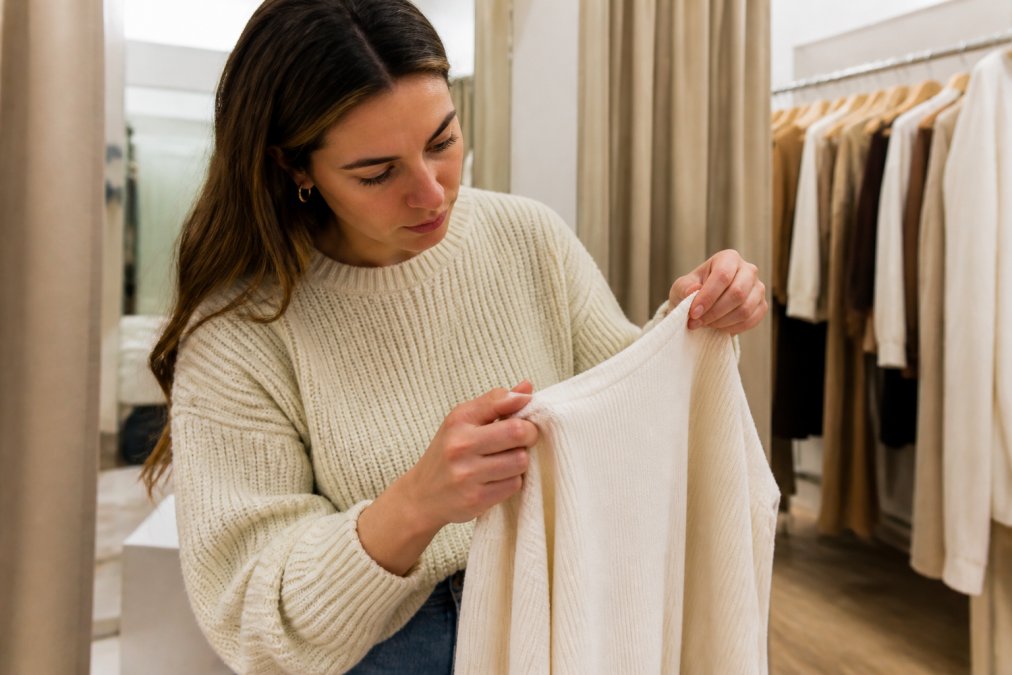
Start with the seams. Turn the garment inside out. A well-made piece has clean, even stitching with no loose threads or skipped sections. If the seam pulls apart when you tug it gently, it will not survive repeated wear.
Seam Integrity, Lining, and Washability Checks
Lining tells you what the brand thinks of its own fabric. A lined skirt or dress usually means the outer fabric is thin enough to need support, which is fine, but it should be attached cleanly at the waistband and hem.
Washability is the check most shoppers skip. Look for care instructions and take them seriously. Fabrics that pill easily, like some synthetic knits, will look worn within a few washes regardless of how good they looked on arrival.
- Turn the garment inside out and inspect every seam
- Tug the side seams gently to test stitch strength
- Check that any lining is attached at both waist and hem
- Read the care label before buying, not after
- Feel the fabric weight against a similar piece you already own
Cost Per Wear: The Math That Settles the Quality Debate
Cost per wear is the price of a garment divided by the number of times you realistically wear it. A $90 cardigan worn 60 times costs $1.50 per wear. A $40 top worn twice costs $20 per wear. The cheaper item lost.
This is the framework that ends the quality debate. Instead of asking whether a piece is "worth it" in the abstract, ask how many wears you'll get and what each one costs you.
A common mistake is buying a low-price item for an occasion you'll attend once, then repeating the pattern monthly. Run the math across a season and the pattern becomes obvious.
| Scenario | Price | Realistic Wears | Cost Per Wear |
|---|---|---|---|
| Occasion top, worn once | $45 | 1 | $45.00 |
| Everyday tee, layered weekly | $49.90 | 50 | $1.00 |
| Neutral cardigan, worn often | $59.90 | 60 | $1.00 |
| Statement piece, worn rarely | $89.90 | 4 | $22.48 |
Affordable Alternatives to High-End Casual Wear That Hold Up
Affordable alternatives to high-end casual wear work best when you build around fabric and fit rather than logos. The pieces below are the ones that earn their place in a rotation.
Modal Easy Fit Tee, $49.90
This is the piece that proves the point. A 95% modal, 5% spandex blend gives it a silky hand feel that reads far more expensive than the price. It runs true to size, sits loose through the bust, waist, and hips, and isn't see-through, which is rare at this price. Layer it under the quarter zip or wear it alone. Shop the Modal Easy Fit Tee.


Modal Scuba Luxe Quarter Zip Pullover, $94.90
The most expensive piece in this lineup, and the one that earns it. The 48% modal, 45% polyester, 7% spandex blend is lightweight but structured, with an oversized fit, bubbled sleeves, and a dropped shoulder. It has a front pocket and pairs directly with the matching joggers. Shop the Modal Scuba Luxe Quarter Zip Pullover.
Modal Scuba Straight Leg Joggers, $89.90
Same fabric family as the pullover, cut with a slightly wide leg and a high-rise elastic drawstring waist.
Just Like Cashmere Button Cardi, $59.90
Crochet Blanket Cardigan, $89.90
What Shopping an Online Clothing Boutique Shipping From Canada Changes
Shipping Logistics, Duties, and Return Processing
Verdict: When the Price Tag Matches the Quality
The Six-Month Wear Test
A Structured Decision Framework
Where the Value Actually Sits
Frequently Asked Questions
Is Petal and Pup quality worth the price compared to fast fashion?
It depends on the fabric composition of the specific piece. Petal and Pup sits above typical fast fashion in garment construction and styling, but the price point only pays off on items you wear often. Run a cost per wear calculation: divide the price by how many times you will realistically wear it. A $90 dress worn 20 times costs $4.50 per wear, which beats a $30 dress worn twice. Check the fabric content and seam integrity before buying, since synthetic materials vary widely in how they hold up after washing.
How does Petal and Pup sizing compare to Canadian standards?
Before ordering, measure your bust, waist, and hips in centimeters and compare them against the specific item's size chart rather than assuming your usual size. If you are between sizes, the larger option is usually the safer call for fitted styles.
What are the benefits of shopping at a Canadian-based boutique?
The biggest practical benefit is shipping logistics. When a boutique ships from within Canada to Canada, there is no duty, no customs brokerage fee, and no overseas return shipping to absorb if something does not fit. That matters because return processing across a border can take weeks and often costs more than the item is worth. A Canadian boutique also tends to stock sizing and seasonal weights suited to the local climate, and customer support responsiveness is easier to manage within the same time zones.
Are there higher-quality alternatives to viral online boutiques?
Yes, and the way to find them is to compare fabric composition and garment construction rather than brand recognition. Look for pieces with a high modal, cotton, or wool content, finished seams, and accurate size charts. Betty Be Good Boutique, for example, stocks a Modal Easy Fit Tee at $49.90 made from 95% modal and 5% spandex, a blend that resists pilling and holds its shape through repeated washing. A higher price does not automatically mean better textile quality, so read the label.
Does Petal and Pup offer easy returns for Canadian customers?
Before ordering from any boutique that ships internationally, read the return window, confirm who pays return freight, and check whether refunds are issued to the original payment method or store credit. A boutique that ships from within Canada removes that friction entirely, since returns stay domestic.
The real challenge in boutique shopping isn't finding something cute. It's finding pieces that survive a season of real wear without losing their shape or their feel. Betty Be Good Boutique curates affordable, on-trend fashions with modal-rich fabrics, true-to-size fit notes, and domestic shipping from within Canada with no duty and no overseas returns. Get started with Betty Be Good Boutique and build a wardrobe where every piece earns its cost per wear.

0 comments