
Canadian Boutiques vs Fast Fashion: 2026 Guide
Posted on September 25 2026

Table of Contents
- Canadian Boutiques vs International Fast Fashion: The 2026 Comparison
- What Sets Canadian Boutiques Apart
- The Fast Fashion Model Explained
- Avoiding Customs Duties on Clothing: What You Need to Know
- Sustainable Clothing Brands: How to Tell Genuine Effort from Greenwashing
- Local Boutique Shopping Benefits: Why Curation Beats Volume
- Cost-Per-Wear: The Math That Changes Everything
- Care and Repair: Making Your Clothes Last Longer
- Building a Capsule Wardrobe with Boutique Pieces
- Frequently Asked Questions
Last Updated: September 25, 2026
Canadian Boutiques vs International Fast Fashion: The 2026 Comparison
Every year, millions of garments pass through Canadian closets and most of them are gone within a season. That turnover is the heart of the fast fashion model, and it's why more shoppers are weighing Canadian boutiques against international fast fashion chains. At Betty Be Good Boutique, we hear the same question from customers: is a curated boutique actually worth it, or is it just a prettier price tag? This guide answers that with real numbers, practical math, and a hard look at what fast fashion costs you over time.
Fast fashion is a retail model built on rapid production cycles, low prices, and high volume, where trend-driven designs move from runway to rack in weeks and are designed to be replaced quickly. Canadian boutiques operate on the opposite logic: smaller runs, handpicked collections, and pieces meant to stay in rotation for years.
That difference shows up in your closet, your wallet, and your environmental footprint.
Below, we'll walk through the fast fashion model, how to avoid customs duties on clothing, how to spot greenwashing, and the cost-per-wear math that changes how you shop.
What Sets Canadian Boutiques Apart
Canadian boutiques win on curation, not volume. A boutique buyer selects a limited number of pieces, which means every item on the rack has to earn its place.
That changes what you bring home. Instead of scrolling thousands of near-identical tops, you're choosing from a tight edit where the colors, cuts, and fabrics were picked to work together. Independent designers and small-batch production also mean fewer people are wearing your exact blouse.
Local boutique shopping benefits extend beyond the rack:
- Fit and fabric get tested in person. You can feel the weight of a fabric before buying.
- Staff know the stock. A boutique owner can tell you how a piece washes and whether it runs true to size.
- Money stays in the local economy. Independent retailers support local jobs and suppliers.
- Returns are simpler. No overseas shipping, no customs paperwork on the way back.
The trade-off is honest: boutiques carry less inventory, so popular sizes sell out. That's the price of curation.
The Fast Fashion Model Explained
The fast fashion model runs on speed and volume, and it works by shortening every step between design and shelf. Trends are copied quickly, production is outsourced to low-cost manufacturing, and new styles drop weekly to keep shoppers returning.
That pace has a cost. Textile waste is one of the fastest-growing waste streams in the world, and synthetic fibers like polyester shed microplastics every time they're washed. Toxic dyes used in some low-cost supply chains can contaminate waterways near production sites.
Supply chain transparency is where the model struggles most. When a garment passes through multiple subcontractors, it becomes hard for anyone, including the brand, to say exactly where it was made or under what conditions. Ethical manufacturing requires visibility that rapid production often doesn't allow.
None of this means every affordable garment is a problem. It means the model rewards speed over garment longevity, and that's a choice you can opt out of.
Avoiding Customs Duties on Clothing: What You Need to Know
The simplest way to avoid customs duties on clothing is to buy from a retailer that already ships from within the country.
Returns are the other half of the equation. A domestic return is a domestic shipment: you pack it, you send it, it arrives. An overseas return means the parcel crosses the border again, and the return shipping, potential re-assessment, and transit time all work against you. For a garment you're unsure about, that friction is often the deciding factor.
Classic Polka Dot Puff Sleeve Blouse →
Sustainable Clothing Brands: How to Tell Genuine Effort from Greenwashing
Genuine sustainable clothing brands show their work; greenwashing hides behind vague language. The difference usually comes down to whether a claim can be checked.
Watch for these signals:
- "Eco-friendly" with no specifics. A real claim names the material, the certification, or the process.
- One green feature as a distraction. A recycled tag on a garment made in an opaque supply chain isn't progress.
- No supply chain transparency. If a brand can't name its factories, it can't verify its own claims.
- Constant newness. A brand dropping hundreds of styles weekly is still a fast fashion model, whatever the label says.
Local Boutique Shopping Benefits: Why Curation Beats Volume
Curation beats volume because it solves the real problem in most closets: pieces that don't work together. A handpicked collection is built so that what you buy actually pairs with what you already own.
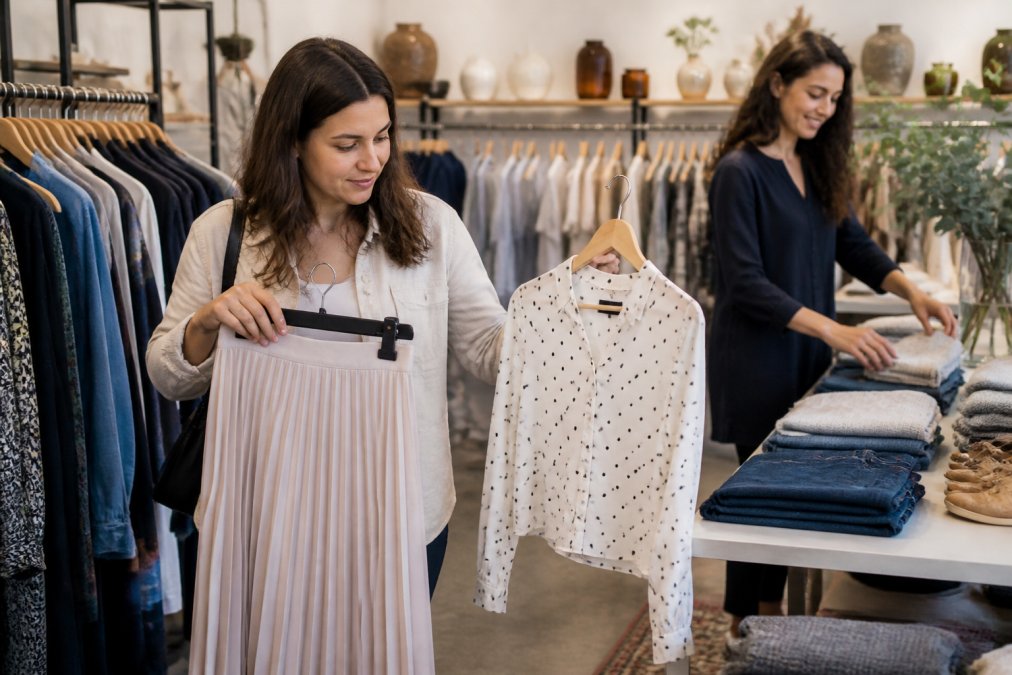
That's what curated collections do. They remove the guesswork.
Cost-Per-Wear: The Math That Changes Everything
Cost-per-wear is the price of a garment divided by the number of times you actually wear it. It's the single most useful number in your closet, and almost nobody calculates it.
| Garment | Price | Wears Per Year | Years Worn | Cost-Per-Wear |
|---|---|---|---|---|
| Classic Polka Dot Puff Sleeve Blouse | $69.90 | 30 | 3 | $0.78 |
| Pleated Midi Skirt | $74.90 | 25 | 3 | $1.00 |
| Crochet Blanket Cardigan | $89.90 | 20 | 4 | $1.12 |
| Vegan Leather Belted Trench Coat | $109.90 | 40 | 4 | $0.69 |
Care and Repair: Making Your Clothes Last Longer
Care and repair are what make the cost-per-wear math work. A well-made garment only pays off if you keep it in rotation, and most shoppers retire pieces for reasons that are entirely fixable.

- Reattach a button. A needle, thread, and five minutes. This is the most common reason a garment gets retired, and the easiest to fix.
- Fix a hem. A dropped stitch or loose hem is a simple hand-sew, not a reason to replace the piece.
- Mend a seam. A small rip along a seam closes quickly with a basic stitch.
- Replace a zipper pull. Often the zipper itself is fine; the pull is what fails. A replacement pull costs almost nothing and takes minutes.
- De-pill a knit. A fabric shaver restores the surface of a sweater that looks tired but is structurally sound.
Building a Capsule Wardrobe with Boutique Pieces
A capsule wardrobe is a small, coordinated set of garments that mix into many outfits, usually built around neutral colors and versatile cuts. The goal is fewer pieces doing more work.
Build it in four steps:
- Audit what you own. Pull out everything you wore in the last month. That's your real baseline.
- Find the gaps. Look for the outfits you keep wanting but can't assemble.
- Pick a color story. Two neutrals plus one accent keeps everything compatible.
- Add slowly. Buy one piece at a time and check it against three existing items before it comes home.
Frequently Asked Questions
What are the benefits of shopping at Canadian boutiques versus international retailers?
Canadian boutiques offer curated selections, personal service, and often carry pieces you will not find in big-box stores. You avoid customs duties on clothing because items ship domestically, and returns go to a local address rather than overseas. Boutiques also tend to prioritize quality over quantity, meaning your pieces last longer and fit into a cohesive wardrobe. For budget-conscious shoppers, the cost-per-wear often ends up lower than fast fashion because garments hold up better and stay in rotation longer.
How does shopping locally help avoid unexpected duty fees?
When you order from an international fast fashion site, your parcel crosses a border and may be subject to customs duties, taxes, and brokerage fees set by the border agency. These charges are often collected by the courier before delivery, adding surprise costs. Shopping from a Canadian boutique means your order ships within Canada, so no customs duties apply. Betty Be Good Boutique ships from within Canada to Canada, so you never face duty charges or the hassle of overseas returns.
Why is fast fashion considered less sustainable than boutique shopping?
Fast fashion relies on rapid production cycles, synthetic fibers, and impulse shopping that leads to textile waste. Many fast fashion garments use toxic dyes and shed microplastics during washing. Boutique shopping, by contrast, often emphasizes garment longevity, natural fabrics, and ethical production. Canadian boutiques typically order in smaller quantities, reducing overproduction. While no brand is perfect, choosing curated pieces from local makers supports a circular economy and reduces your environmental footprint compared to buying disposable trend items.
What makes Canadian-curated fashion a better long-term investment?
Canadian-curated fashion focuses on wardrobe staples that transcend seasons, rather than fleeting trends. A quality blouse or tailored trousers cost more upfront but deliver a lower cost-per-wear because you reach for them repeatedly. Boutiques also prioritize fit and fabric, so pieces resist pilling and fading. Over a year, replacing cheap items three times costs more than investing once in a well-made garment. This quality-over-quantity approach builds a wardrobe that stays stylish and functional.
How does the return process differ between local boutiques and international fast fashion sites?
Returning to an international fast fashion site often means shipping the item back overseas at your own expense, waiting weeks for processing, and sometimes paying return shipping or restocking fees. Local boutiques typically offer simpler returns: you send the item to a domestic address, and refunds process faster. Some boutiques even allow in-store returns if you live nearby. Betty Be Good Boutique ships from within Canada, so returns stay domestic, avoiding customs delays and high international postage costs.

0 comments