
How to Build a Cohesive Capsule Wardrobe in 2026
Posted on September 16 2026

Table of Contents
- Start With a Wardrobe Audit, Not a Shopping List
- How to Choose a Color Palette for Clothes That Mix Easily
- A Capsule Wardrobe Checklist for Beginners (With Item Counts)
- Fill Your Wardrobe Gaps With Versatile Basics
- Trendy Outfits for Moms 2026: Where Trends Fit Inside a Capsule
- Make It Last: Fabric Care, Cost-Per-Wear, and Budget Building
- Frequently Asked Questions
Last Updated: September 16, 2026
Start With a Wardrobe Audit, Not a Shopping List
A capsule wardrobe is a small, curated collection of clothing that mixes and matches to create many outfits from few pieces. Learning how to build a cohesive capsule wardrobe starts with subtraction, not addition. This guide walks through the audit, the color rules, the item counts, and the maintenance habits that make it work.
Sort Every Item Into Keep, Repair, Donate, or Sell
Pull everything out. Yes, everything, including the bin under the bed and the coat you only wear in February. Then sort each piece into four piles:
- Keep: Fits well, you wore it in the past year, and it works with at least two other pieces
- Repair: Loose buttons, small tears, stretched seams, a hem that needs taking up
- Donate: Good condition, wrong size or style for you
- Sell: Higher-value pieces in good shape
The Three-Question Test for the Maybe Pile
Every audit produces a maybe pile. Run each item through three questions before it earns a spot back in the closet:
- Does it fit right now? Not the size you're working toward, the body you have today.
- Does it match at least three other keepers? If it only works with one outfit, it's an orphan.
- Would you buy it again at full price? If the answer is no, it's taking up space a better piece could use.
Track What You Actually Wear for Two Weeks
Before buying anything, note what you reach for daily for fourteen days. Most people find they wear roughly a fifth of their closet on repeat. Those repeat pieces tell you your true style identity, and they become the foundation of your capsule.
Edit, Don't Just Sort
Sorting is the easy half. Editing is deciding what the closet is for. Once the keep pile is set, group it by category, tops, bottoms, layers, dresses, shoes, outerwear, and look at the ratios. If you kept twelve tops and three bottoms, the imbalance is the problem, not the number of pieces.
What to Do With the Donate and Sell Piles
Donate bags should leave the house the same week, not sit in the trunk as a permanent passenger. For the sell pile, photograph items in daylight, list them with measurements, and price to move rather than to maximize. A piece that sells for a modest amount this month beats one that sits in a bin for a year.
Why the Audit Comes Before the Palette
You can't choose a color palette for clothes you don't actually wear. The audit reveals which neutrals already dominate your keep pile and which accents you reach for without thinking. That evidence, not a Pinterest board, is what should shape the capsule that follows.
How to Choose a Color Palette for Clothes That Mix Easily
The easiest color strategy for a capsule is two neutrals plus two accents. Neutrals handle the base layers; accents add personality without breaking outfit combinations.
Build Around Two Neutrals and Two Accents
Pick neutrals you'll actually wear: black and cream, navy and grey, or camel and white. Then choose two accents you love, like rust and olive or blush and denim blue.
A Capsule Wardrobe Checklist for Beginners (With Item Counts)
A beginner capsule usually lands between 30 and 40 pieces, including shoes but excluding outerwear and gym clothes. The exact number matters less than the ratio.
The Capsule Ratio: How Many Tops, Bottoms, and Layers
| Category | Item Count | Examples |
|---|---|---|
| Tops | 8-10 | Tees, blouses, sweaters |
| Bottoms | 5-6 | Jeans, trousers, skirts |
| Layers | 3-4 | Blazers, cardigans, vests |
| Dresses | 2-3 | Day-to-evening styles |
| Shoes | 4-5 | Sneakers, flats, boots |
| Outerwear | 2-3 | Coat, jacket, trench |
This capsule ratio keeps outfit combinations in the hundreds while your closet stays small. Print the checklist and tick items off as you fill them.
Fill Your Wardrobe Gaps With Versatile Basics
Versatile basics are the pieces you wear weekly, wash often, and can dress up or down. Buy these first, and the rest of the capsule falls into place.
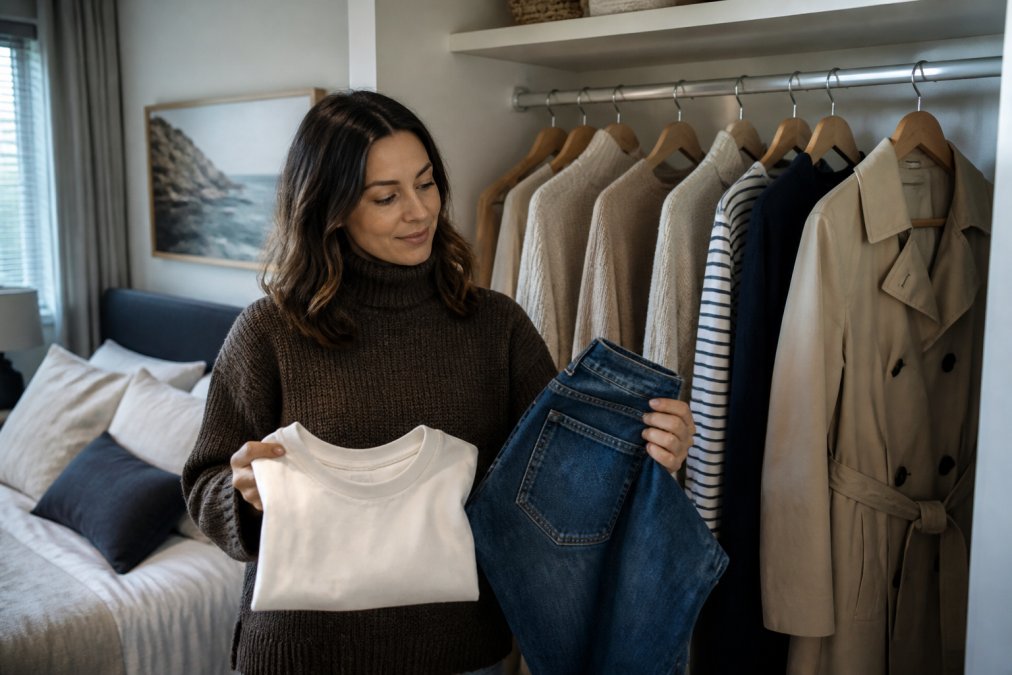
Four Pieces That Do the Heavy Lifting
- A silky-soft tee. The Modal Easy Fit Tee layers under blazers, tucks into denim, and works for lounging or errands.
- Dark high-rise denim. The High-Rise Cuff Boyfriend Jeans pair with nearly every top in the capsule.
- A neutral knit. The Natural Mock Neck Sweater adds warmth without bulk.
- A statement layer. The Vegan Leather Belted Trench Coat finishes an outfit in one step.
Trendy Outfits for Moms 2026: Where Trends Fit Inside a Capsule
Trends belong in your accent pieces, not your foundation. If wide-leg denim is having a moment, buy one pair in your neutral, not five in five colors.


Make It Last: Fabric Care, Cost-Per-Wear, and Budget Building
Most capsule guides stop at the shopping list. The pieces only stay cohesive if they survive repeated wear, and the wardrobe only stays affordable if you build it in phases. This is the part the SERP skips, and it's the part that decides whether your capsule lasts one season or five.
Cost-Per-Wear Is the Only Price That Matters
Cost-per-wear is the price of a garment divided by how many times you wear it. A $50 top worn 50 times costs a dollar per wear; a $20 top worn twice costs ten. Quality over quantity wins on math alone, but only if the quality piece actually gets worn.
Fabric Care by Material
Different fabrics fail in different ways. Match the care to the fiber and the capsule holds its shape:
- Knitwear (wool, cashmere, cotton blends): Wash inside out in cold water on a gentle cycle, or hand wash. Never wring. Lay flat to dry on a towel, reshaping while damp. Store folded, not hung, so shoulders keep their shape and the knit doesn't stretch on the hanger.
- Denim: Turn inside out before washing, use cold water, and skip the dryer entirely. Heat breaks down stretch fibers and fades indigo. Wash less often than you think, spot-clean between wears and air denim out overnight.
- Silk and modal: Hand wash or use a mesh bag on a delicate cycle. Cold water only. Hang or lay flat to dry away from direct sun, which yellows light-colored silk over time.
- Linen: Gets softer with washing. Cold water, gentle cycle, and either line dry or tumble on low. Press while slightly damp for a crisp finish.
- Outerwear and structured layers: Spot-clean where possible. Dry clean sparingly, the solvents are hard on coatings and vegan leather. Wipe vegan leather with a damp cloth and store on a padded hanger to avoid creasing.
Store It Like You Mean to Keep It
Storage is half of longevity. Sweaters folded, denim folded or hung by the waistband, dresses and coats on sturdy hangers that won't leave shoulder bumps. Cedar blocks or lavender sachets keep moths away from wool without the smell of mothballs. Off-season pieces go into breathable cotton storage bags, not vacuum-sealed plastic, which traps moisture and can yellow natural fibers.
Build the Capsule in Phases, Not One Shopping Spree
Budget-conscious capsule building works in phases. Replacing a whole wardrobe at once is what makes capsules feel expensive; replacing one worn-out staple at a time is what makes them affordable.
A practical sequence:
- Phase one, foundations. Replace the two or three pieces you wear most often and that are visibly worn: the everyday tee, the jeans, the neutral knit.
- Phase two, gaps. Fill the holes the audit revealed. If you have no layer between a tee and a coat, that's the gap, not a fourth pair of black trousers.
- Phase three, accents. Add the trend piece or the color you love, once the base is solid.
Sustainable Isn't a Price Point, It's a Habit
Sustainable fashion isn't about spending more; it's about buying less and keeping it longer. The most sustainable garment in your closet is the one you already own and still wear. Care, repair, and rotation do more for longevity than any label claim.
A simple maintenance rhythm keeps the capsule intact:
- Weekly: Air out worn-but-not-dirty pieces, spot-clean, and put shoes back on the rack.
- Monthly: Check for loose buttons, pilling, and small tears. Fix them before they become reasons to replace.
- Seasonally: Wash and store off-season pieces properly, review what you didn't wear, and plan the next phase of the build.
Frequently Asked Questions
What is the 3-3-3 rule for a capsule wardrobe?
The 3-3-3 rule is a starting framework: three tops, three bottoms, and three pairs of shoes that all work together. In practice, that gives you 27 outfit combinations from nine pieces, which is enough for a week of work and weekend wear. Use it as a training exercise if a full capsule feels overwhelming. Once you see how often you reach for the same nine items, adding layers and accessories becomes easier to judge.
How many items should be in a cohesive capsule wardrobe?
Most capsules land between 30 and 40 pieces, counting tops, bottoms, layers, shoes, and outerwear but not accessories, sleepwear, or workout gear. The number matters less than the overlap: every top should work with at least three bottoms. If you are starting a capsule wardrobe checklist for beginners, aim for 25 to 30 pieces for your first season and adjust from there.
How do I choose a color palette for my capsule wardrobe?
Pick two neutrals you already wear often, such as black and cream or navy and beige, then add two accent colors you enjoy. Every new piece should match at least two items you own. Hold fabrics next to each other in daylight before buying. A tight palette is what makes a capsule feel cohesive rather than random, and it cuts the time you spend deciding what to wear each morning.
Can a capsule wardrobe be trendy and stylish?
Yes. Keep the bulk of your capsule in timeless essentials and use one or two trend pieces per season for personality. For 2026, that might mean a mock neck sweater in a fresh neutral or a belted trench coat with a relaxed fit. Because your basics stay consistent, a single trend piece reads as intentional styling rather than a random purchase you can only wear one way.


0 comments