
Is Elevated Casual Style Worth the Investment in 2026?
Posted on September 26 2026

Table of Contents
- What Elevated Casual Actually Means (and Why It Costs More)
- The Cost Per Wear Calculation That Changes Everything
- How to Style Elevated Casual Outfits Without a Stylist
- Capsule Wardrobe Essentials for Moms Building a Curated Closet
- How to Spot Well-Made Garments Before You Buy
- Is Elevated Casual Style Worth the Investment? The Honest Pros and Cons
- Frequently Asked Questions
Last Updated: September 26, 2026
What Elevated Casual Actually Means (and Why It Costs More)
Deciding whether elevated casual style is worth the investment starts with understanding what you're actually paying for. Elevated casual is a polished, intentional way of dressing that sits between relaxed everyday wear and formal business attire, built from well-made staple pieces rather than trend-driven fast fashion. At Betty Be Good Boutique, we see this play out daily: a customer swaps three flimsy tops for one structured blouse and suddenly has five outfits instead of one.
The cost gap comes down to construction and fabric. A tailored waistband, front pleat detailing, or a lined seam takes more time and better material than a basic knit pull-on. That's the trade: fewer pieces, each doing more work.
The Cost Per Wear Calculation That Changes Everything
Cost per wear (CPW) is the single most useful number in this entire decision, and almost no style guide actually shows you how to calculate it. Here is the formula:
CPW = (Purchase price + alteration cost + maintenance cost) ÷ Total wears over the garment's life
That last variable is the one people get wrong. "Total wears" is not how often you wear it this month. It is how many times you will realistically wear it before the fabric pills, fades, or loses shape. A well-constructed blouse in a mid-weight woven can hold up for 100+ wears with normal care. A thin fast-fashion knit often shows wear by wear 15 to 20.
Worked example, same $60 budget:
| Fast-fashion top | Elevated casual blouse | |
|---|---|---|
| Price | $20 | $60 |
| Realistic wears before visible wear | 15 | 90 |
| CPW | $1.33 | $0.67 |
Same money spent, half the cost per wear, because the denominator is six times larger. This is the mechanism most "is it worth it" articles skip.
The break-even rule of thumb: if a piece costs three times more than the cheap alternative, it needs to last at least three times as long to justify the price on CPW alone. Anything beyond that is a bonus. Most elevated casual staples clear this bar easily because construction, not branding, drives the longevity.
Versatility multiplies the denominator. A top that pairs with four bottoms gets worn roughly four times as often as a statement piece that only works with one outfit. Before you buy, count the existing pieces in your closet it coordinates with. Fewer than three is a warning sign.
Alterations belong in the numerator. A $25 hem or waist take-in on a $70 trouser raises the cost basis, but it also raises the wear count because the fit is now correct. Factor it in honestly rather than pretending tailoring is free.
A common pattern is that people judge value by the price tag alone. The tag tells you the numerator. The fabric, the fit, and your existing closet tell you the denominator, and the denominator is where the real answer lives.
How to Style Elevated Casual Outfits Without a Stylist
The fastest route to a pulled-together look is a simple formula: one structured piece, one relaxed piece, and one grounding neutral. Smart casual styling rewards contrast in texture and silhouette rather than volume of clothing.
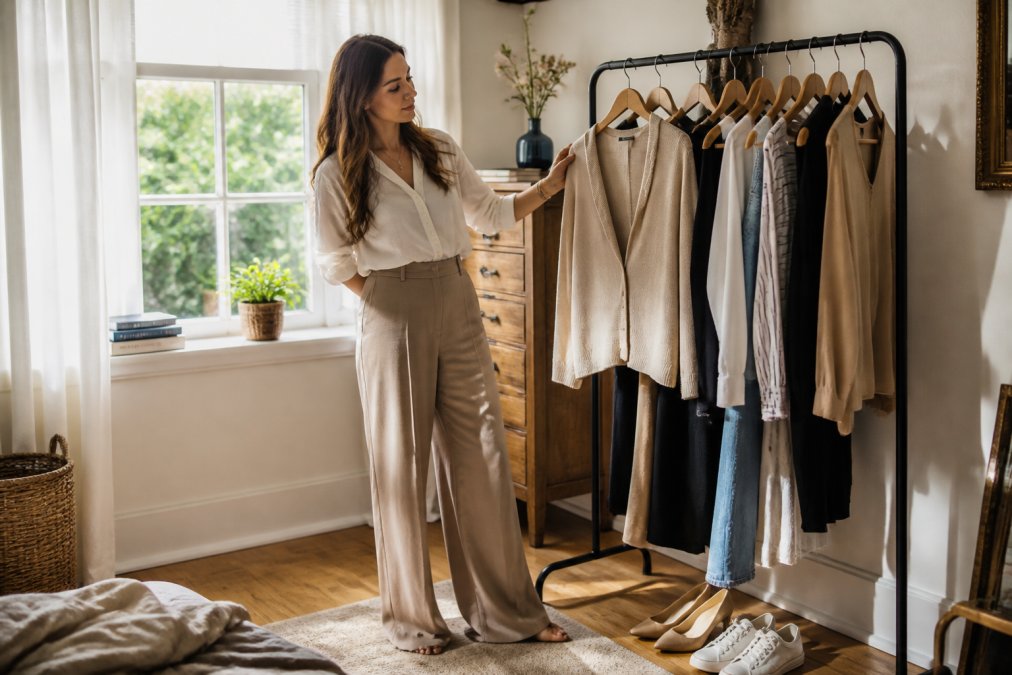
Try these combinations:
- Tailored trousers with a relaxed blouse and flat shoes
- Wide-leg denim with a fitted knit and a structured tote
- A flowy top tucked into a high-rise bottom to define the waist
- One metal tone across jewelry, hardware, and belt
Fit and silhouette carry more weight than brand names. If the shoulders sit right and the hem lands where it should, the outfit reads as intentional even when every piece is budget-friendly.

Capsule Wardrobe Essentials for Moms Building a Curated Closet
Capsule wardrobe essentials for moms start with pieces that survive real life: school runs, work, and everything after. The goal is a curated closet where nearly every item pairs with at least three others.
| Category | Piece to Prioritize | Why It Earns Its Place |
|---|---|---|
| Bottoms | Tailored wide-leg trouser | Works for work and weekends |
| Bottoms | High-rise palazzo denim | Smooths and stretches with you |
| Tops | Flowy V-neck blouse | Layers under vests and jackets |
| Tops | Textured V-neck top | Dresses up with one jewelry change |
| Outerwear | Neutral vest or cardigan | Bridges seasons without bulk |
Start with a wardrobe audit. Pull everything out, set aside what no longer fits your life stage, and note the gaps. Most people discover they own plenty of tops and almost no bottoms that actually fit.
How to Spot Well-Made Garments Before You Buy
Quality is not a vibe. It is a set of checkable signals, and the most important one is the fiber content tag, not the price tag.
Start with fabric science. Natural fibers and quality blends behave very differently from thin synthetics over time:
Jacquard Ribbed District Tailored →
- Wool resists odor and holds shape through many wears between washes, which is why it dominates tailoring.
- Linen gets softer with washing and lasts decades, but wrinkles by design. That is a feature, not a defect.
- Silk drapes and takes dye beautifully but is sensitive to sweat and sunlight, so it wears faster in high-contact pieces.
- Cotton is durable and breathable; a dense cotton poplin outlasts a loose weave every time.
- Synthetics (polyester, acrylic, nylon) are not automatically bad. A tight polyester-spandex blend resists bagging at knees and elbows better than a loose knit. The problem is thin, loose synthetics that pill and shine within a season.
The check you can do in ten seconds: pinch the fabric and release.
Then check construction:
-
Seams: even stitching, no loose threads, no puckering. Turn the garment inside out and look at the interior finish.
-
Hardware: zippers glide without catching, buttons feel solid, no sharp edges on snaps or clasps.
-
Lining: a cleanly finished interior signals care. Raw, fraying interior seams signal the opposite.
-
Fit: shoulders sit at your natural shoulder line, and the hem lands where the designer intended.
-
Hem: $15 to $30 to shorten trousers or sleeves to your exact length.
-
Waist take-in: $20 to $40 to remove gaping at the back of a skirt or trouser.
-
Sleeve taper: $15 to $25 to slim a boxy sleeve into a cleaner line.
-
Shoulder adjustment: the most expensive alteration, often $40 to $80, and usually not worth it on a budget piece.
Care label reality check. A piece that requires dry cleaning after every wear has a hidden cost that belongs in your cost-per-wear math. Machine-washable wools and cottons deliver more wears per dollar for most people than delicate fabrics that sit in the closet waiting for a trip to the cleaners.
Is Elevated Casual Style Worth the Investment? The Honest Pros and Cons
For most wardrobes, yes, elevated casual style is worth the investment when you buy deliberately rather than constantly. The math favors fewer, better pieces over a rotating pile of cheap ones, and the styling effort drops once your closet is cohesive.
Pros:
- Lower cost per wear over time
- Easier outfit decisions each morning
- Pieces that transition across settings
- Less waste, which aligns with slow fashion values
Cons:
- Higher upfront cost per item
- Requires patience to build gradually
- Some structured pieces need tailoring or careful washing
Frequently Asked Questions
What is the 3-3-3 rule for clothing?
The 3-3-3 rule is a packing and wardrobe strategy: three tops, three bottoms, and three pairs of shoes can create 27 different outfit combinations. It works because each piece is chosen to coordinate with the others, which is the same principle behind a capsule wardrobe. When you apply it to elevated casual style, you end up with a small rotation of versatile pieces that mix easily, reduce decision fatigue, and get worn far more often than impulse buys.
How can I build an elevated casual wardrobe on a budget?
Start with a wardrobe audit: pull out everything you wore in the last month and note what is missing. Then invest in one or two structured pieces that anchor multiple outfits, such as tailored trousers or a textured V-neck top, and build around those. Calculate cost per wear before buying. A $60 top worn 40 times costs $1.50 per wear; a $20 top worn twice costs $10. Shopping a curated boutique with transparent pricing helps you avoid fast-fashion traps.
Is it better to buy fewer high-quality pieces or more trendy items?
For most people, fewer high-quality pieces deliver better long-term value. Trend-driven items often lose relevance within a season and depreciate quickly, while classic silhouettes and structured pieces stay wearable for years. A small rotation of well-made garments also simplifies getting dressed. That said, you can mix in one or two affordable trend pieces per season to keep things fresh without undermining your cost per wear.
What clothing items are worth investing in for a capsule wardrobe?
Prioritize pieces that work across multiple settings: tailored trousers, a flowy blouse in a neutral or classic print, a textured V-neck top, and well-fitted denim with structure. These earn their place because they pair with almost everything else in your closet. Look for natural fibers or quality blends, functional pockets, and finishes like pleat detailing or a tailored waistband. Each piece should create at least three outfits with items you already own.

0 comments